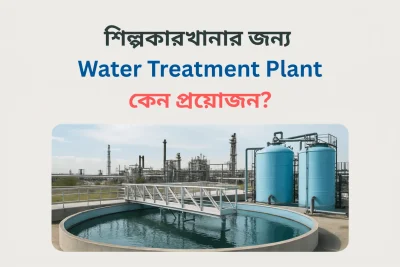
Water plays a critical role in almost every industrial process—from manufacturing and food processing to pharmaceuticals and power generation. However, untreated water often contains dissolved salts, heavy metals, bacteria, and other impurities that can damage equipment and affect product quality.
This is where Reverse Osmosis (RO) Water Treatment Systems become essential. Industrial RO systems are designed to remove dissolved solids and contaminants, ensuring high-quality water for production processes.
In this article, we explain how RO water treatment works in industrial plants, its key components, and why it is essential for modern industries.
Industrial processes require consistent water quality. Without proper treatment, raw water can cause serious operational problems such as:
- Scaling in Equipment
Hard minerals like calcium and magnesium form scale inside boilers, heat exchangers, and pipelines.
- Corrosion
Impurities can cause corrosion in metal equipment, leading to expensive maintenance.
- Product Quality Issues
Industries such as pharmaceuticals and food processing require ultra-pure water to maintain quality standards.
- Regulatory Compliance
Many industries must follow environmental regulations regarding water use and wastewater discharge.
Industrial RO systems help solve these problems by providing stable, high-quality water.
Key Components of an Industrial RO Systems
A well-designed RO plant consists of several important components working together:
- Pre-Treatment System
Before water enters the RO membrane, it passes through pre-treatment stages such as:
- Sand Filter – removes suspended particles
- Carbon Filter – removes chlorine and organic matter
- Water Softener or Anti-Scalant Dosing – prevents scaling
Pre-treatment is crucial because it protects the RO membrane from damage.
- High Pressure Pump
RO membranes require high pressure to push water through the semi-permeable membrane. Industrial systems use high-pressure pumps to generate this force.
- RO Membrane
The membrane is the core component of the system.
It separates water into two streams:
- Permeate: purified water
- Reject (Concentrate): water containing dissolved contaminants
Modern RO membranes are capable of removing extremely fine impurities measured in microns and dissolved ions.
- Post Treatment System
After filtration, additional treatment may be used depending on the industrial requirement, such as:
- UV Sterilization
- Ozonation
- Mineral Adjustment
- Storage and distribution
Step-by-Step Process of Industrial RO Water Treatment
Step 1: Raw Water Intake
Water is collected from sources such as groundwater, surface water, or municipal supply.
Step 2: Pre-Filtration
Large particles, sediments, and chlorine are removed using filtration systems.
Step 3: High-Pressure Pumping
The water is pressurized to force it through the RO membrane.
Step 4: Membrane Separation
The membrane separates clean water from dissolved impurities.
Step 5: Purified Water Storage
The treated water is stored in tanks for use in industrial operations.
Industries That Use RO Water Treatment
RO systems are widely used in many industries, including:
- Food and Beverage Industry
- Pharmaceutical Manufacturing
- Textile and Dyeing Industry
- Power Plants
- Chemical Manufacturing
- Electronics Industry
- Boiler Feed Water Systems
Each industry requires customized RO plant designs depending on water quality and production demand.
Advantages of Industrial RO Water Treatment
High Purity Water
Removes up to 99% of dissolved contaminants.
Energy Efficient Technology
Modern RO systems consume less energy compared to traditional purification methods.
Reduced Maintenance Cost
Prevents scaling and corrosion in equipment.
Environmentally Friendly
Helps industries reduce chemical usage and wastewater pollution.
Scalable Capacity
Industrial RO plants can be designed for capacities ranging from 500 LPH to several hundred cubic meters per day.
Maintenance of Industrial RO Systems
To maintain system performance, regular maintenance is essential:
- Membrane cleaning and replacement
- Filter replacement
- Pump and pressure monitoring
- Chemical dosing adjustments
- System performance testing
Proper maintenance ensures longer membrane life and stable water quality.
Choosing the Right RO Water Treatment System
Selecting the right industrial RO system depends on several factors:
- Raw water quality
- Required production capacity
- Industrial application
- Operating cost and maintenance
Working with experienced water treatment engineers ensures the system is properly designed, installed, and maintained.
Conclusion
Reverse Osmosis technology has become one of the most reliable and efficient water purification solutions for industrial plants. By removing dissolved salts, contaminants, and microorganisms, industrial RO systems help industries maintain product quality, protect equipment, and meet environmental standards.
Investing in a properly designed RO water treatment plant ensures long-term operational efficiency and sustainable water management.
Contact us for more details:
Waterpro Corporation
Mobile: +8801798844060